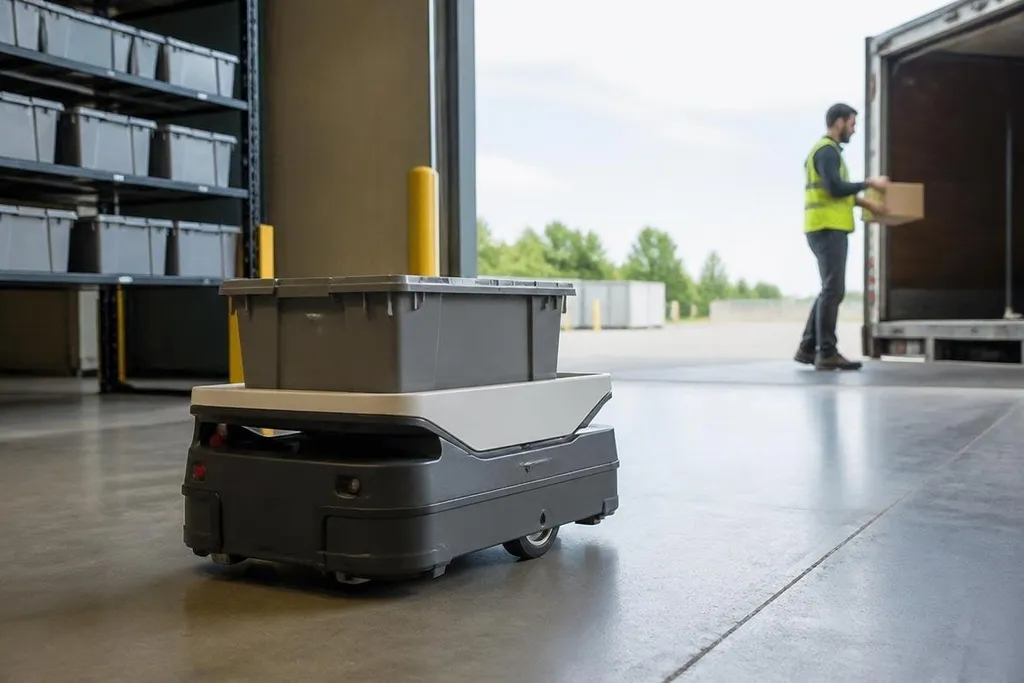
A shipping robot may move a tote across a warehouse, carry a parcel between buildings, or guide a trailer through a yard. Its value comes from repeating that trip safely and predictably while people handle work that needs judgment.
For operations managers, the question is practical: which parts of shipping can a robot handle today, and where will people still need to step in?
- Robots cut repeated travel inside warehouses and yards.
- Sensors help them avoid people, racks, vehicles, and other machines.
- The hard part is still unusual freight, changing layouts, and safe handoffs.
Where shipping robots fit
Shipping covers more ground than the final trip to a customer. Parcels move through receiving areas, storage aisles, sortation lines, loading docks, trailer yards, and delivery routes. One robot can work in one of those places without taking on the whole chain.
An autonomous mobile robot, or AMR, uses cameras, LiDAR, and software to move through a mapped area. LiDAR measures distance with light, so the robot can detect racks, walls, people, and vehicles as it travels.
A robotic arm can then pick a parcel, while a conveyor moves it through a fixed path. That division matters because each system suits a different part of shipping.
Fixed equipment works well when every parcel follows the same route. AMRs fit sites where routes change during a shift. Robotic arms help when a task needs reach and force, but they still need known item sizes, safe grasp points, and clear space around the load.
Why the work needs automation
Shipping teams spend many hours moving items between steps. That travel adds no value to the parcel, yet it takes time, floor space, and attention from workers who could inspect damaged boxes or fix an exception.
Robots can keep these moves running through the day, but their usefulness depends on the task. One carrying sealed totes between storage and packing has a clearer job than one asked to sort every type of parcel from a mixed pile. Boxes with loose wrapping, soft bags, or poor labels create harder decisions.
Labor is one reason companies look at automation, but it isn't the only one. A machine can repeat a route with the same speed, record its position, and stop when its sensors detect a blocked path. Those records can help a manager find delays that are hard to see from a dashboard built around shipment totals.
A shipping manager comparing a route robot needs evidence from the job site, not a company name alone. Shipping robot reports from Robot24.com can tie each claim to the task, test site, and date before the next section examines where these machines still struggle.
What robots still struggle with
A shipping robot needs more than motors and sensors. It needs a safe operating area, charging space, network access, clear traffic rules, and staff who can recover a stopped machine. Each part affects the result.
A mapped warehouse can change when a rack moves or a pallet blocks an aisle. The robot may stop rather than make a risky guess. That is the right response for safety, but repeated stops can reduce the work completed during a shift.
The handoff creates another limit. The robot may carry a tote to a packing station, but a person may still need to check the label, open damaged packaging, or place an unusual item into a container. Automation moves the task boundary. It rarely removes every task around it.
I’d choose a robot for repeated internal transport before buying one for mixed parcel handling. The first job has a clear route and a measurable result; the second depends on many edge cases that product videos often skip.
A practical buying check
Before you compare robot models, write down the task in physical terms. A useful check should answer these points:
- Route: measure the distance, floor surface, doorways, ramps, and places where people cross.
- Load: record parcel sizes, weights, shapes, and the share that arrives damaged or loose.
- Handoff: name the person, machine, or conveyor that receives each load.
- Safety: set the stopping rules, warning zones, emergency controls, and recovery process.
- Proof: run a limited site test and count completed trips, stops, damaged items, and staff interventions.
That last measure keeps the discussion tied to work completed, not robot movement on its own. A machine that travels well but waits beside a blocked dock may add little to the shipping process.
Shipping robots are becoming more important because parcel movement contains many repeated trips, while the cost of delays reaches every later step. The next useful proof is simple: how many complete shipments can the system move in a real shift, with people and exceptions included?